Why a Simple Gesture Means More Than Hello When You’re Riding Alone.
There are days when I ride because I want to see the world, and there are days when I ride because I need to escape it. On those latter days, the ones where the noise of modern life feels like static interference, the isolation of the helmet is a relief. I am sealed off, anonymous, and moving through the landscape like a ghost.
But even in that sought-after solitude, there is a paradox. I want to be alone, but I don’t want to feel alone.
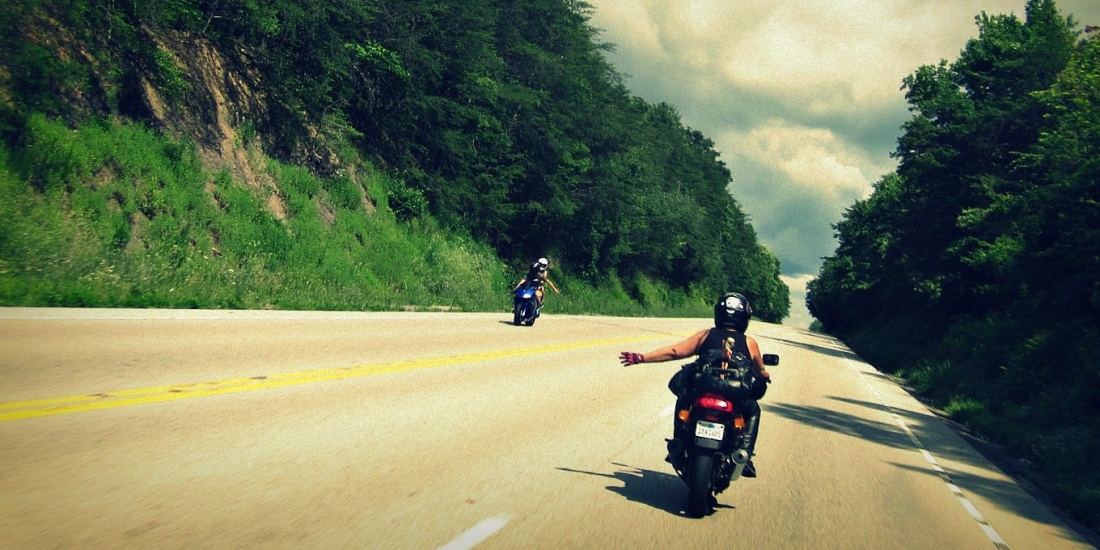
Then, it happens. A silhouette approaches in the opposite lane. A single headlight cuts through the daylight. As we close the gap at a combined speed of 180 km/h, a left hand drops from the handlebars. Two fingers point toward the asphalt. I drop mine in return.
The interaction lasts less than a second. We pass, and the moment is gone. But in that fleeting exchange, something profound shifts. I am no longer just a solitary figure on a machine; I am part of a tribe.
The Code of “I See You”
To the uninitiated, the “Moto Wave” — two fingers extended low — might look like a cool affectation or a secret club handshake. But for those of us in the saddle, it is a language of survival and acknowledgment.
When I’m out on the road, surrounded by steel cages whose drivers are distracted by phones, heated arguments, or navigation screens, I often feel invisible. To them, I am an obstacle, a variable, or worse, empty space. That invisibility is the rider’s greatest danger.
The wave breaks that invisibility. When another rider drops their hand, they are saying, “I see you.” It is an affirmation of existence in a world that often looks right through us. It’s a silent confirmation that, for this brief moment, we are sharing the same reality, the same risks, and the same wind. It validates my presence on the road in a way that no car driver ever could.
The Great Equalizer
What I love most about this gesture is its ability to dissolve boundaries. In the “real world,” we are separated by income, politics, age, and profession. We sort ourselves into boxes. But on the road, those boxes shatter.
I have exchanged the wave with patched-up club members on roaring Harley-Davidsons while I was on an electric moped. I’ve signaled to teenagers on 50cc scooters and retirees on fully-loaded Gold Wings. In that split second, the specific badge on the tank doesn’t matter. The price tag of the gear doesn’t matter.
The wave is the great equalizer. It strips away the pretension and boils the interaction down to the absolute core: you are on two wheels, I am on two wheels, and we are both out here exposed to the elements. It creates a temporary, rolling community that exists without meetings, dues, or words. It is solidarity in its purest form.
A Lifeline on the Heavy Days
I’ll be honest: there are rides I’ve taken where my head wasn’t in the right place. Rides taken to outrun a bout of depression or to process a grief that felt too heavy to carry at home. On those rides, the isolation can sometimes turn dark. The helmet can feel less like a sanctuary and more like an echo chamber for negative thoughts.
It is on those specific days that the wave feels less like a greeting and more like a lifeline. Seeing that hand drop is a reminder that I am not the only one fighting the wind. It pulls me out of my internal spiral and forces me to engage with the world outside my visor.
It’s a strange comfort to know that a complete stranger, someone I will never meet and whose face I will never see, took a second out of their ride to wish me safe passage. It’s a tiny spark of human connection in a mechanical act. Sometimes, that spark is just enough to light the way home.
Keeping the Rubber Side Down
The specific geometry of the wave — two fingers pointing down — is intentional. It’s not a peace sign in the wind; it’s a directive. “Keep two wheels on the ground.” “Keep the rubber side down.”
It is a benediction. We all know the stakes. We know that gravel happens, that deer jump, and that left-turning cars don’t look. By dropping a hand, we are acknowledging that shared vulnerability. We are wishing each other survival.
It’s a heavy thing to communicate at 90 km/h, but we understand it instinctively. It’s why, when I see a rider stopped on the shoulder, I slow down. It’s why I tap my helmet to warn an oncoming rider of a speed trap or a hazard. The wave is just the opening sentence of a longer conversation about mutual protection.
The Silent Tribe
The next time you’re out on a solo loop, feeling the weight of the week or the sting of loneliness, wait for that headlight. When the hand drops, feel the weight of it.
You aren’t just passing traffic. You are participating in a ritual that spans borders and generations. You are acknowledging a stranger, and they are acknowledging you. In a world that is increasingly disconnected and digital, that analog, flesh-and-blood signal is a powerful thing.
You might be riding solo, but you are never truly riding alone.
How does the wave make you feel? Is it just habit, or does it give you that same sense of connection? And be honest: do you wave at the scooters?
Leave a Reply