
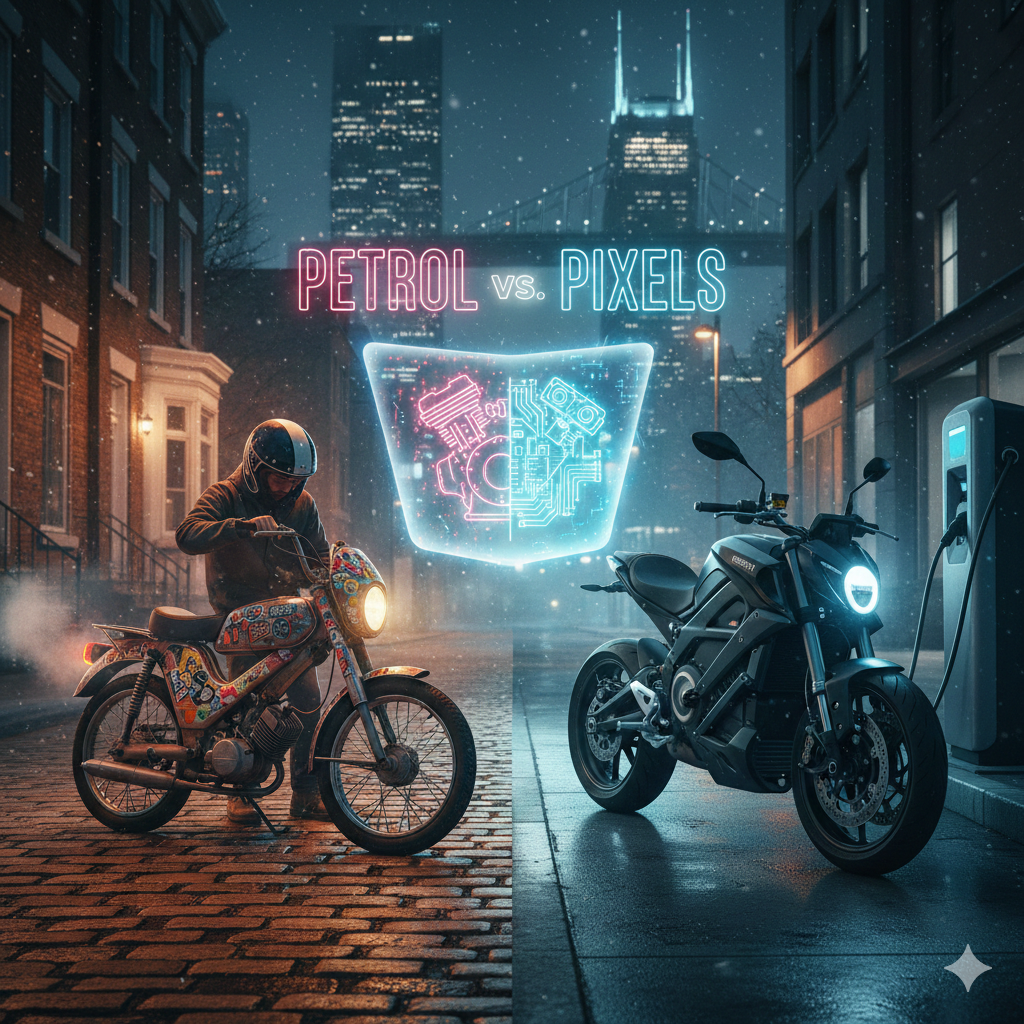
Navigating the High-Voltage Future and the Internal Combustion Heritage of the 514.
The Ghost in the Machine
It is a Saturday morning in the Mile End. The usual soundtrack of the neighborhood is a chaotic symphony: the rattle of the 55 bus, the distant clang of construction, and the familiar, smoky “pop-pop-pop” of a 1978 Peugeot moped warming up outside a cafe. But lately, a new sound — or rather, a new silence — has begun to weave through the traffic. It is a digital hum, a faint jet-turbine whine that disappears as quickly as it arrives.
The electric revolution has landed on the island of Montréal.
For the traditionalist, the motorcycle is defined by the explosion. It is a machine of fire, vibration, and mechanical percussion. For the new guard, the motorcycle is defined by the surge — a seamless, instant delivery of torque that feels less like a machine and more like an extension of one’s own nervous system. As we sit in the heart of winter, plotting our 2026 season, the question is no longer if electric bikes are coming, but whether they can truly capture the gritty, resilient soul of riding in a city like ours.
The 2-Stroke Romance and the Smell of the Plateau
To understand what electric technology is up against, you have to understand the cult of the petrol moped in Montréal. There is an undeniable romance in the analog. When you ride a vintage petrol moped through the Plateau, you are part of a sensory experience. You smell the pre-mix oil; you feel the heat of the engine against your legs; you learn to “read” the vibrations through the handlebars to know exactly when your spark plug is fouling.
Petrol bikes are visceral. They are “fixable” with a flathead screwdriver and a bit of Québécois ingenuity. In a city that loves its heritage — from its architecture to its bagels — the petrol engine feels like a piece of history you can kick-start into life. There is a “theatre” to internal combustion that a battery, no matter how efficient, struggles to replicate. When you downshift a petrol bike entering a tunnel on the Ville-Marie, the mechanical roar is a form of communication. It tells the city you are there.
The Electric Surge: Torque for the Urban Slalom
But then, you twist the throttle of a modern electric motorcycle, and the argument begins to shift.
If petrol is theatre, electric is magic. In the stop-and-go combat of Montréal traffic, the electric motor is a tactical masterstroke. There is no clutch to feather in the grueling crawl of the Décarie, no gears to hunt for when a delivery truck suddenly cuts you off on Boul. Saint-Laurent. Electric bikes offer 100% of their torque at zero RPM. This means that from a red light, an electric bike doesn’t just accelerate; it teleports.
In the “Montréal Slalom” — that frantic dance between orange cones and potholes — the weight distribution of electric bikes (with their heavy batteries mounted low) provides a center of gravity that makes them feel impossibly planted. For the urban commuter, the benefits are becoming impossible to ignore. No oil changes, no valve adjustments, and a “fuel” cost that is essentially pennies on the dollar thanks to our abundance of Hydro-Québec power. We live in a province defined by electricity; there is something poetically “Québécois” about powering your commute with the same northern rivers that define our geography.
The Winter Constraint: Batteries vs. The Big Cold
However, we live in a city where the mercury can drop to -30°C. For the Montréal rider, the battery isn’t just a power source; it’s a living thing that hates the cold as much as we do.
This is the current frontier of the technology. While petrol bikes can be winterized with a simple battery tender and some fuel stabilizer, electric bikes require a different kind of mechanical empathy. Lithium-ion batteries lose significant range when the temperature dips, and for the “hardcore” Montréal riders who try to push their season into late November, “range anxiety” becomes a very real factor.
But the 2026 landscape is changing. We are seeing the rise of swappable battery technology. Imagine stopping at a station in Old Montréal, sliding out a depleted battery the size of a briefcase, and sliding in a fresh one in thirty seconds. This tech, already booming in cities like Taipei and Paris, is the “Holy Grail” for a dense city like ours where most riders live in apartments and don’t have a private garage to plug into overnight.
The Soul is in the Ride
The debate between petrol and electric often gets stuck in the “either/or” trap. But the soul of the Montréal scene isn’t found in the fuel tank — it’s found in the freedom of the two wheels.
A vintage Vespa and a high-tech Zero motorcycle are both tools for the same job: the pursuit of the open air. The “soul” of a bike isn’t just the noise it makes; it’s the way it carves through a corner on the way up to Mont-Royal. It’s the way it allows you to see the city not as a series of traffic jams, but as a playground.
As electric technology evolves, we are seeing the birth of “e-mopeds” that look like vintage cafe racers and “e-scooters” that can outrun sportbikes. The technology is becoming more “human.” It’s getting lighter, faster, and — most importantly — more stylish.
Choosing Your Current
Whether you prefer the oily rag and the rhythmic pulse of a piston or the silent, surgical precision of a motor, the 2026 season in Montréal promises to be the most diverse one yet. We are entering an era where the “exhaust note” might be replaced by the sound of the wind, but the thrill remains unchanged.
The petrol engine gave us the 20th century. Electricity might just save our 21st-century city streets from the noise and the smog, leaving us with nothing but the pure, unadulterated joy of the ride.
So, as you sit by the heater this January, ask yourself: are you waiting for the spark of a plug, or the surge of a circuit?
Leave a Reply