
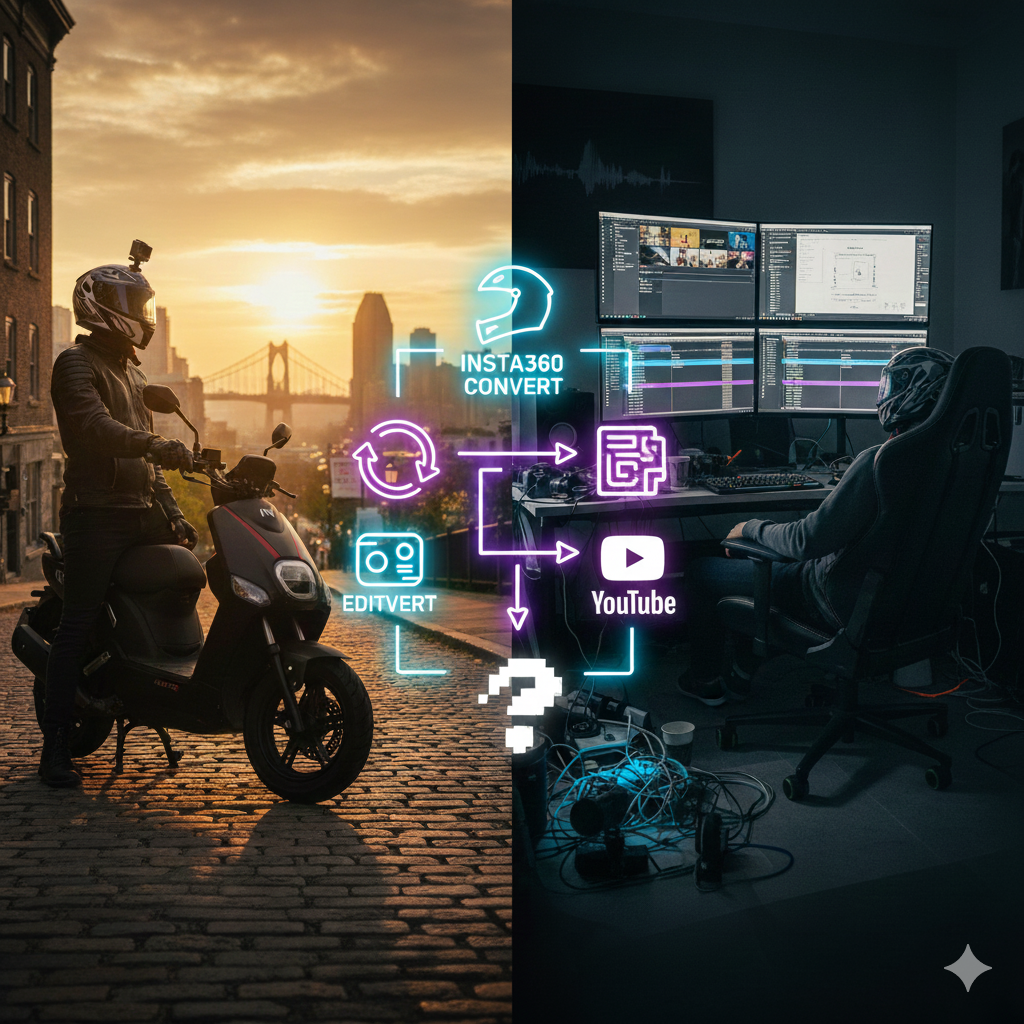
From Website Woes to YouTube Thumbnails: Peeking Behind the Helmet Cam.
The Illusion of Effortless Freedom
On a perfect summer evening in Montréal, there’s nothing quite like it. The sun dips low, painting the Lachine Canal in hues of orange and purple. You’re on your bike, the wind is perfect, and the city hums around you. You capture that moment on your helmet cam, maybe a quick piece-to-camera about the joy of it all. Later that night, you upload a slick video to YouTube or a perfectly crafted blog post. It looks effortless. It feels free.
But for those of us who create content — whether it’s a moto vlog, a blog, or a simple social media post — we know a different reality. That “effortless freedom” is often the result of dozens of hours of unseen work, fueled by caffeine, frustration, and a deep, sometimes masochistic, love for the process. This isn’t just about riding; it’s about building a bridge between the raw experience and the polished story, a bridge that’s often paved with late nights and technical headaches.
The Digital Garage: More Than Just Wrenching
I’ve just spent over 20 hours tweaking the design of this very website. Twenty hours. That’s more time than some spend doing oil changes, tire rotations, and chain adjustments combined in a season. And that’s just the design. This digital garage, much like our physical ones in the brutal Montréal winter, requires constant attention, upgrades, and troubleshooting.
For a new blogger or vlogger, the learning curve is less a curve and more a sheer cliff face. There’s the initial setup: understanding domains, hosting, WordPress themes, and plugins. Then comes the maintenance: security updates, optimizing for speed, and making sure your site doesn’t crash after a software update. It’s a continuous battle against broken links, unresponsive layouts, and the ever-present threat of spam comments. We meticulously tune our carburetors for the perfect idle; we spend just as much, if not more, time debugging a CSS file for the perfect pixel.
The Filming Frontier: Capturing the Ephemeral
Then there’s the actual act of capturing the ride. It sounds simple: just hit record. But any moto vlogger will tell you it’s a complex ballet of technical considerations and environmental challenges.
First, the gear. Cameras like the Insta360, while incredible for their 360-degree footage, produce massive, proprietary files. You don’t just “transfer” these; you first have to use specific software to “stitch” them, “reframing” the footage into a usable flat video format. This alone can be a time-consuming, processor-intensive task that adds hours before you even begin to edit. You’re constantly battling battery life in cold Montréal weather, ensuring lenses are clean despite road grime, and dealing with wind noise that can ruin perfectly good audio.
Beyond the technical, there’s the art of being present. You’re riding, navigating Montréal’s treacherous roads, being aware of traffic, and simultaneously trying to narrate, capture specific shots, and remember key moments. It’s a multi-tasking challenge that can take away from the pure joy of the ride itself, transforming a leisure activity into a production.
The Editing Dungeon: Where Raw Footage Becomes a Story
This is where the magic (and the madness) truly happens. You’ve got hours of raw footage, often from multiple cameras. The process involves:
- Ingestion: Transferring massive files, a task that can take hours depending on file size and internet speed.
- Cutting: Sifting through endless footage, trimming out the boring parts, the shaky parts, the “I forgot to turn the mic on” parts.
- Storytelling: Weaving together disparate clips, adding music, graphics, and sound effects to create a cohesive narrative. This is where you transform a simple ride into an engaging story.
- Audio Sweetening: Removing wind noise, balancing dialogue, and ensuring the bike’s engine note sounds just right.
- Color Grading: Making sure the Montréal skyline looks as vibrant on screen as it did in real life.
Each minute of a polished video can easily represent an hour or more of editing time. It’s a painstaking process that demands patience, a keen eye for detail, and a decent computer that doesn’t crash every five minutes.
The Algorithmic Battle: Titles, Tags, and Thumbnails
Finally, you have your masterpiece. But the work isn’t over. Now comes the battle for visibility in the vast digital ocean of YouTube and Google. This is where the artistry meets the algorithms:
- Title & Description: Crafting compelling titles that grab attention while also including crucial SEO keywords (e.g., “Montréal NIU NQi GTS,” “Electric Moped Review 514”). The description isn’t just a summary; it’s another chance to feed the algorithm with relevant terms and links.
- Hashtags: Researching and implementing the right hashtags to categorize your content and reach niche audiences.
- The Unforgiving Thumbnail: This is arguably the most critical element. The thumbnail is your video’s billboard. It needs to be visually striking, convey the essence of the video, and compel a click — all in a tiny, static image. Hours can be spent on this single graphic, testing different fonts, colors, and compositions, because a great video with a bad thumbnail will simply never be seen.
The Fuel of Passion
Why do we do it? Why dedicate untold hours to editing, writing, and troubleshooting when we could just be riding?
Because for the Montréal rider, sharing the experience is part of the ride itself. It’s about building a community, inspiring others, and showcasing the unique beauty and challenges of our city’s two-wheeled world. It’s a different kind of resilience — the resilience of showing up, creating, and pushing through the digital grind to share the freedom of the road.
So, the next time you watch a smooth moto vlog or read a well-crafted blog post, take a moment to appreciate the unseen journey behind it. It’s often as challenging, and as rewarding, as the ride itself.
Leave a Reply