
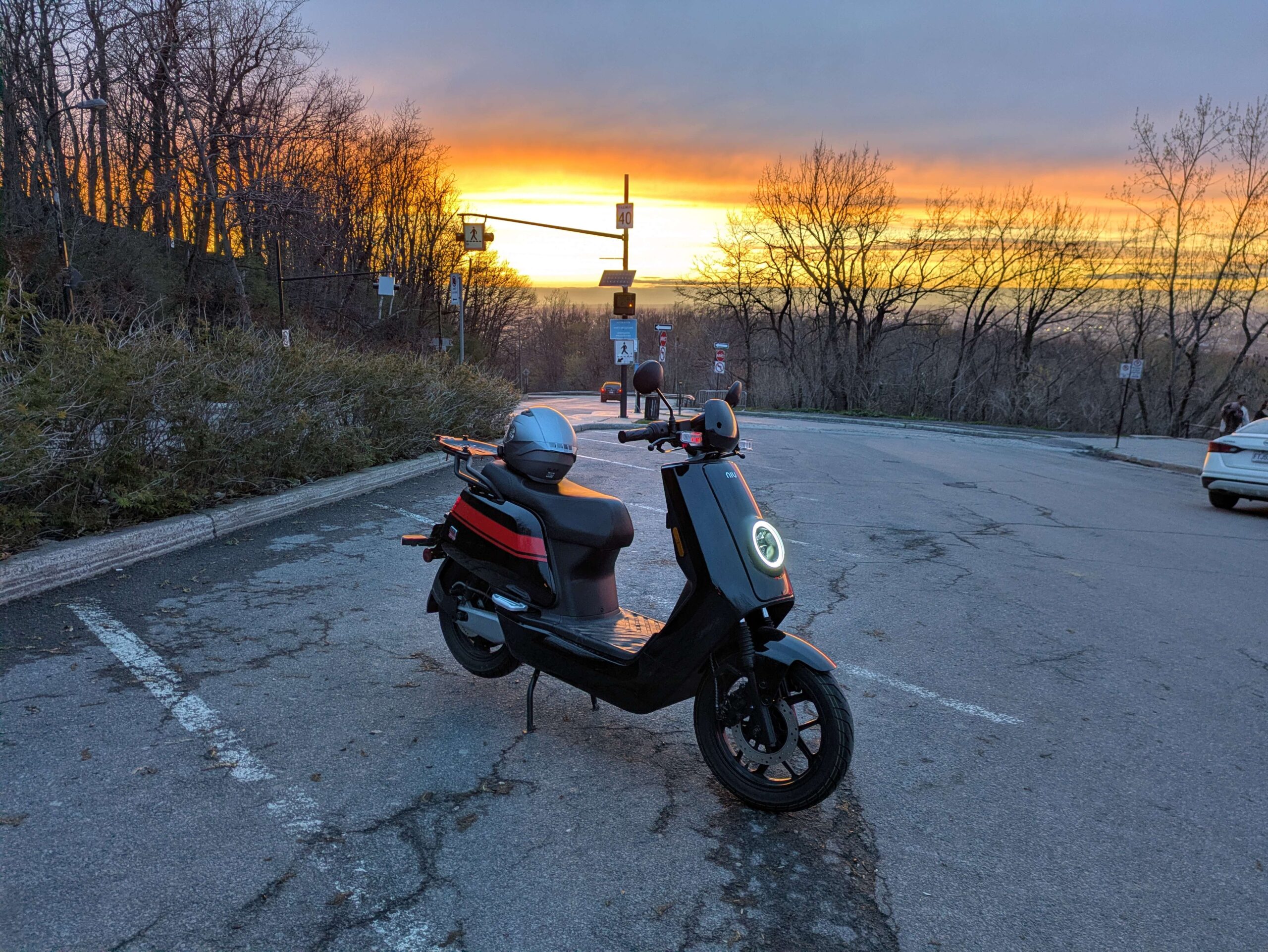
Passing a major mileage milestone on any vehicle is a satisfying feeling, but on an electric moped navigating the unique, rugged streets of Montreal, it feels like a genuine achievement. Having recently crossed the 5,000-kilometer mark on a NIU NQi GTS electric scooter, it is time to look back at what it is actually like to live with this machine day in and day out.
If you have been eyeing an electric moped as a solution to your daily urban commute, you have probably noticed a lot of surface-level marketing material. But what happens when the spec sheets meet the realities of potholes, unpredictable weather, and traffic laws?
Here is an exhaustive, real-world review of the NIU NQi GTS after 5,000 kilometres of city riding.
The Backstory: From E-Bike Loopholes to a Class 6D License
To understand why the NQi GTS is such a vital tool for city commuting, we have to look back at the rapidly shifting legal landscape of two-wheeled transport in Quebec.
The journey actually began with a different machine: a NIU UQi+. Legally classified as an electric bicycle, the UQi+ featured pedals but was styled to look exactly like a miniature moped. At the time, the law was relatively simple: keep the motor under 500 Watts, restrict the speed to 32 km/h, keep the pedals functional, and you could ride anywhere a bicycle could go without a license, registration, or insurance.
However, as e-bikes resembling mopeds exploded in popularity on city streets, public frustration grew. In response, the provincial government introduced sudden, overnight restrictions that effectively banned these types of vehicles from being operated on public roads as simple bicycles. The UQi+ suddenly became a vehicle that could not be legally ridden or sold in the province, leaving many units relegated to backyards.
Rather than giving up on the freedom of two wheels, the logical next step was to transition to a legal, registered moped. In Quebec, this requires obtaining a Class 6D scooter license (or holding a standard passenger car license). A Class 6D license permits you to ride any moped or scooter with an engine displacement of 50cc or less, or an electric equivalent, restricted to a top speed of 70 km/h.
This legal transition is what led to the purchase of the NIU NQi GTS.
Technical Specifications: What You are Actually Riding
The NQi GTS is classified in many jurisdictions as a 125cc-equivalent scooter due to its power and speed. However, because its top speed is electronically governed to 70–75 km/h, it fits snugly into Quebec’s 50cc-equivalent moped category. This offers riders a major advantage: 125cc-level acceleration and presence, but with the cheaper registration, insurance, and licensing requirements of a 50cc moped.
The vehicle reviewed here is an early 2022 model. While NIU introduces incremental improvements to their lineup every year, the core architecture of this model remains highly competitive.
The Dry Specs:
- Connectivity: Integrated 4G telematics control unit with GPS tracking and a dedicated mobile app.
- Motor: 3,000 Watt (3 kW) continuous Bosch hub motor built directly into the rear wheel.
- Top Speed: 70 to 75 km/h in Sport mode.
- Wheels: 14-inch alloy wheels (providing significantly more stability over potholes than traditional 10-inch scooter wheels).
- Ground Clearance: 180 mm (18 cm).
- Seat Height: 815 mm.
- Weight: 113 kg base weight. With both 12.5 kg batteries installed, the total riding weight is roughly 138 kg.
- Braking System: Combined Braking System (CBS) with hydraulic disc brakes front and rear, complemented by a regenerative Electronic Braking System (EBS).
Performance on the Street: Three Modes, Three Personalities
Urban commuting is all about adaptability. The NQi GTS handles this through three distinct riding modes, which you can toggle on the fly using a handlebar switch:
Eco Mode (Max Speed: 25 km/h)
Eco mode is designed for maximum energy conservation. In practice, the acceleration is incredibly sluggish, and the 25 km/h speed cap is too slow for most public roads, occasionally making you a target for impatient drivers. This mode is best reserved for navigating tight parking garages, slow-moving traffic jams, or when you are desperately trying to limp home on a nearly depleted battery.
Dynamic Mode (Max Speed: 45 km/h)
Dynamic mode is the sweet spot for residential city streets. In Montreal, many residential zones have speed limits set to 30 or 40 km/h. Toggling into Dynamic mode gives you respectable, smooth acceleration while automatically capping your speed at 45 km/h. This is incredibly helpful because it allows you to pin the throttle to keep up with the natural flow of neighbourhood traffic without ever having to worry about accidentally speeding.
Sport Mode (Max Speed: 70–75 km/h)
Sport mode unlocks the full potential of the 3 kW Bosch motor. This is where the instant torque of an electric drivetrain truly shines.
Unlike a traditional gas-powered 50cc scooter — which often sounds like a struggling lawnmower, takes several seconds to engage its CVT clutch, and slowly climbs to speed — the NQi GTS reacts instantly. When the light turns green, you twist the throttle and immediately pull ahead of the pack of cars. This instant response is a major safety feature, allowing you to establish your lane position and escape the crowded blind spots of larger vehicles before they even begin to accelerate.
Sport mode also provides the power needed to safely cross multi-lane boulevards or climb the steep, rolling hills of the city without losing momentum.
Handling and Urban Navigation
Thanks to its 14-inch wheels and centralized battery placement under the floorboards and seat, the NQi GTS feels incredibly stable and nimble. It handles like a classic moped: light, responsive, and easy to toss into corners.
Whether you are navigating the island of Montreal, crossing the Jacques Cartier Bridge, or riding across the river into Laval (Jesus Island), the scooter feels confident. The larger wheel diameter over standard scooters means that minor cracks and road imperfections do not upset your line.
However, riding in a busy city requires constant vigilance. Because the electric motor is virtually silent, pedestrians and cyclists will not hear you coming. Practising defensive riding skills — constantly scanning your mirrors, performing deep shoulder checks before any lane change, and keeping your fingers hovering over the brake levers — is absolutely essential.
The Braking System: Combined Braking vs. Independent Control
The NQi GTS features a Combined Braking System (CBS).
- The Left Brake Lever: Pulling the left lever activates both the front and rear hydraulic brakes simultaneously, while engaging the regenerative engine braking to send energy back into the batteries.
- The Right Brake Lever: Pulling the right lever acts strictly on the front hydraulic brake.
For beginners, CBS is a fantastic safety feature. It ensures that even in a panic-braking situation, the scooter distributes stopping force to both wheels, reducing the risk of locking up the rear tire.
However, for riders with experience on larger motorcycles, the lack of independent control can feel a bit restrictive. Over time, as you develop your riding skills, you may find yourself wanting to modulate the front and rear brakes independently to help settle the chassis in tight corners.
A Maintenance Note: Watch Your Brake Fluid
During a recent service tune-up, the technician did not completely fill the brake fluid reservoirs. Over time, as the brake pads wore down slightly, a large air bubble formed in the sight glass of the left master cylinder.
In a hydraulic system, liquids are incompressible, but air is highly compressible. When air enters the lines, it absorbs the pressure from the lever, making the brakes feel sluggish, spongy, and less responsive. If you notice a large bubble in your fluid container or feel your stopping distance increasing, it is time to immediately check your fluid levels and bleed the lines. Thankfully, after 5,000 kilometres, the physical brake pads themselves remain in excellent shape, showing plenty of life for several thousand more kilometres.
The Cold, Hard Truth About Battery Range and charging
If there is one area where electric vehicle marketing tends to stretch the truth, it is range.
NIU advertises an impressive “on-paper” range of up to 165 kilometres for the Extended Range model. However, you have to read the fine print. That figure is calculated with a 40 kg (90 lb) rider travelling at a continuous 25 km/h on completely flat ground in warm weather. In other words, a scenario that does not exist in real-world commuting.
The Realistic Range
In the real world, you are riding in Sport or Dynamic mode to keep up with traffic, dealing with wind resistance, climbing hills, and carrying a normal adult payload.
In these conditions, the battery consumption is roughly 1% of battery life per 1 kilometre travelled. This means your absolute maximum physical range is around 100 kilometres.
The 15% Battery Trap
However, there is a critical feature built into all NIU vehicles that you must plan around: the 15% safety threshold.
The moment your battery level drops to 15%, the scooter’s computer automatically disables Sport and Dynamic modes, forcing the vehicle into Eco mode. Suddenly, your top speed is cut to 25 km/h. If you are riding on a fast, busy boulevard when this happens, it can be a highly stressful experience as traffic suddenly begins rushing past you.
Because of this, your usable range is actually 85% of your battery capacity. To commute safely and maintain traffic speeds, you should calculate your maximum trip distance at 80 kilometres on a full charge.
When planning trips, always apply the divide-by-two rule: you have a maximum radius of 40 kilometres out, and 40 kilometres to get back.
The Impact of Cold Weather
Like all electric vehicles utilizing Lithium-ion batteries, the NQi GTS is sensitive to the cold. During early spring or late autumn rides in Montreal, the freezing ambient temperatures slow down the chemical reactions inside the battery cells. This causes the battery to use more energy to move the vehicle, resulting in a slightly lower overall range on cold days.
Charging Logistics
The GTS features dual 60V 35Ah batteries. Charging from 0% to 100% takes roughly 6 to 8 hours. Because of this charge time, you cannot treat an electric moped like a gas moped — you cannot simply stop at a station for a two-minute fill-up. Every long trip requires destination planning.
The scooter uses standard 110/120V household outlets. The charging brick is quite large and comes with a heavy-duty splitter, allowing you to carry the batteries indoors (they weigh about 12.5 kg each) and charge them simultaneously in your apartment or office.
If you have a garage or an exterior outlet, you can leave the batteries in the scooter and plug the charger directly into a port located underneath the seat. One important safety tip: the charger gets quite warm during use, so always ensure it is kept in the shade or indoors, away from direct sunlight, to prevent overheating.
Build Quality: Steel Frames and the “Plastic Problem”
Underneath its exterior, the NQi GTS features a robust, heavy-duty steel frame. This solid skeleton is highly durable and handles the mechanical stress of daily riding beautifully.
Unfortunately, the outer body panels are constructed entirely of moulded plastic. While this keeps the moped lightweight and affordable, it struggles against the relentless vibrations of city streets.
The Cracked Panel Issue
At around 5,000 kilometres, a side plastic panel running along the lower edge of the frame began to crack. Upon closer inspection, the plastic mounting hole holding one of the structural screws near the kickstand had completely sheared off. Because of the constant shaking of the road, the panel was left vibrating loose against the frame.
The panel was replaced at an official service centre. The parts and labour costs are broken down below:
| Expense Item | Cost (CAD) |
| Replacement Side Panel | $89.00 |
| Service Labor | $35.00 |
| Total Cost | $124.00 (+taxes) |
While $124 CAD is incredibly cheap compared to any car repair, it highlight’s the scooter’s main structural weakness. Traditional scooters, like classic Vespas, utilize stamped sheet-metal monocoque frames, and dual-sports like the Honda Ruckus use exposed steel tubing. Had the NIU utilized metal panels in these high-vibration areas, it likely would have survived the city roads without cracking.
Montreal Road Realities: Orange Cones and Shock Absorbers
You cannot write a Montreal road review without mentioning the city’s unofficial mascot: the orange construction cone.
Between endless roadwork and crumbling asphalt, your suspension is put to the test every single second you are on the road. The NQi GTS features dual rear shock absorbers, but they are tuned quite stiffly to handle the weight of the dual batteries and a potential passenger.
On smooth pavement, the ride is comfortable. But on rough, patched city streets, you will feel every single bump. The suspension works incredibly hard, and the physical impacts are transferred directly up through the seat.
If you do hit a major pothole, the city actually has strict bylaws regarding vehicle damage claims: you must submit a claim for compensation within 15 days of the incident (though you have up to three years to claim for bodily injury). Given how difficult it is to prove a pothole caused a specific crack in a plastic panel, it is usually easier to simply ride defensively and steer clear of the worst road craters.
The App: GPS Tracking and a Stolen Scooter Recovery Story
One of the standout features of the NIU ecosystem is its dedicated smart app. By binding the app to your scooter via its onboard 4G SIM card, you gain access to a wealth of real-time data:
- Riding Data: Tracks every trip you take, mapping your exact route, distance travelled, time elapsed, and average speeds.
- Battery Diagnostics: Displays individual cell temperatures, precise charge percentages, and historical cycle counts.
- Smart Check: Runs a remote diagnostic scan of the moped’s electronic control unit (ECU), motor controller, and braking sensors, confirming 100% performance health.
The Anti-Theft GPS Savior
The most valuable feature of the app, however, is its built-in GPS tracker and motion alarm. The scooter constantly monitors for abnormal vibrations. If someone touches or moves your parked moped without the key, your phone instantly receives a push notification, showing the vehicle’s live location on a map.
This feature was put to the ultimate test when the previous UQi+ was stolen from a city street. Within seconds of the theft, the app alerted that the vehicle was moving. By tracking the live GPS signal on the map, the scooter was located parked behind a building just two hours later. After a quick call to the police, the officers arrived, arrested the individual, and the scooter was successfully recovered.
For city dwellers who worry about street parking, this GPS tracking system alone is worth the price of admission.
Final Verdict: Is the NIU NQi GTS Right for You?
After 5,000 kilometres, the NIU NQi GTS has proven itself to be a highly capable, reliable, and incredibly fun urban commuter.
Who is this scooter for?
It is perfect for the local daily commuter, students, and urban errand-runners. If your daily travel consists of navigating city streets, commuting to work or school, and doing light grocery runs using the built-in bag hook, this electric moped is an absolute joy. It offers instant torque, zero emissions, negligible fuel costs, and a highly advanced security system.
Who is it NOT for?
It is not designed for long-distance touring, highway travel, or exploring rural regions. If you need to leave the city, travel on roads with speed limits above 70 km/h, or ride for hours without worrying about finding a standard wall outlet, an electric moped is going to feel incredibly limiting.
Would I buy it again?
The answer is both yes and no.
For the current situation — relying on a nimble, cost-effective vehicle for pure urban commuting within Montreal — yes, the NQi GTS is a fantastic tool.
However, Canada is the second-largest country in the world by landmass, and there is a massive world of highways, mountain passes, and rural landscapes left to explore. Because an electric moped is ultimately restricted by its 80-kilometer usable range and lack of fast-charging infrastructure, the next step in this journey is to take motorcycle classes and upgrade to a full-fledged, gas-powered motorcycle.
But as far as city commuting goes? The NIU NQi GTS has more than earned its keep.


Leave a Reply