
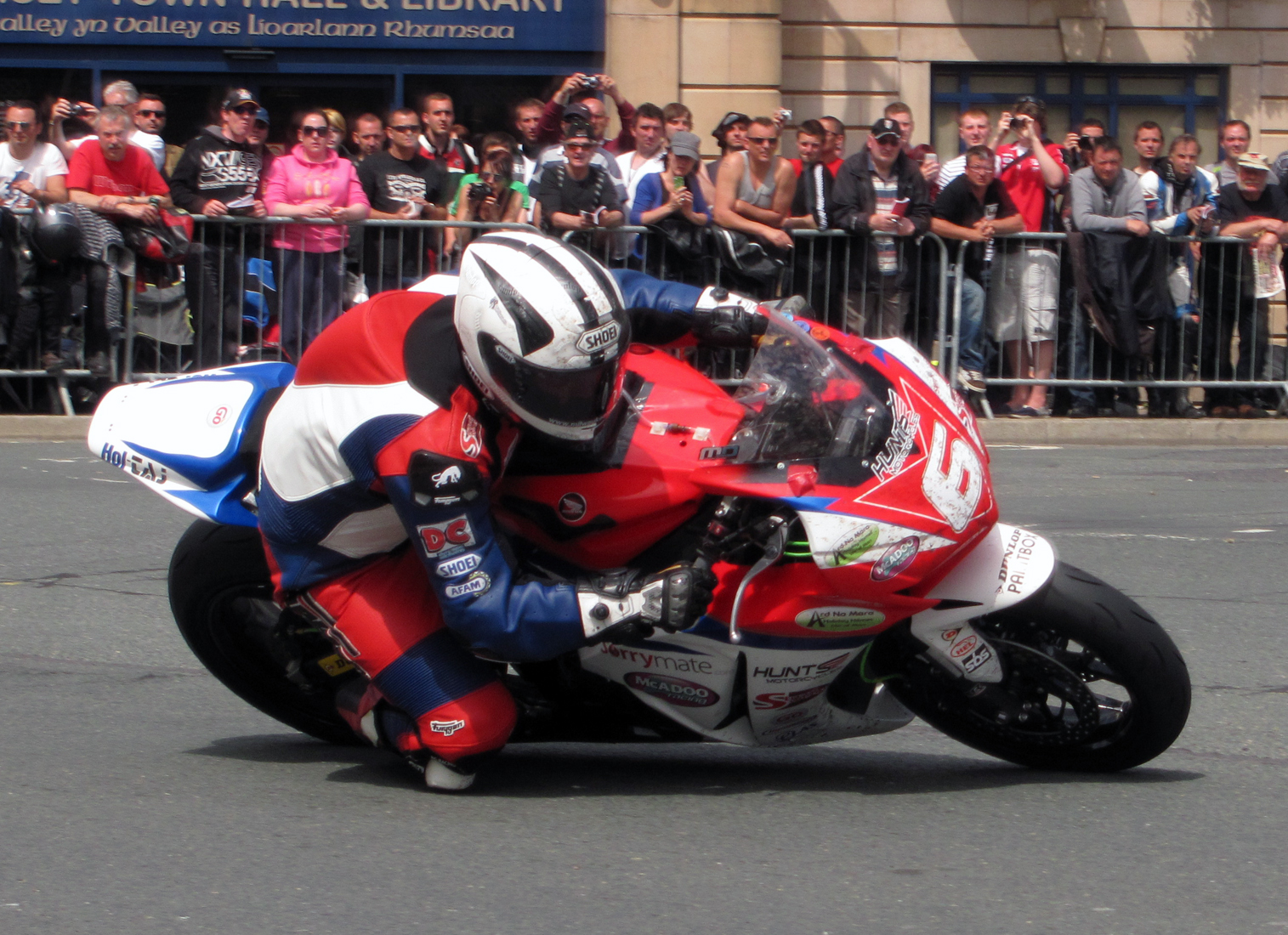
The Isle of Man TT (Tourist Trophy) is not just a motorcycle race; it is a pilgrimage. For two weeks every year, a quiet, windswept island in the Irish Sea transforms into the most revered, and feared, motorsport arena on earth. To understand the TT, you have to look back at how it began and why it remains the ultimate test of human and mechanical endurance.
The Genesis of the Mountain Course: A Brief History of the TT
The story of the Isle of Man TT begins with a rebellion against the rules of the mainland. In the early 1900s, the United Kingdom introduced the Motor Car Act, which imposed a strict 20 mph speed limit across the country and strictly forbade racing on public roads. For the pioneers of early motorsport, this was a death knell. They needed a place where the limits of speed and engineering could be tested without the interference of the law.
They found their sanctuary on the Isle of Man. Thanks to the island’s independent parliament, the Tynwald, local authorities were able to pass legislation that allowed public roads to be closed for racing. In 1907, the first official Tourist Trophy race was held. It was a rugged, dusty affair on the shorter St John’s Short Course, with single-cylinder machines averaging roughly 38 mph.
But the true legend of the TT was born a few years later, in 1911, when the racing moved to the Snaefell Mountain Course.
The Mountain Course is a monstrous 37.73-mile (60.7 km) loop carved directly into the island’s everyday infrastructure. It is not a sterile, purpose-built track with gravel run-off areas and tire walls. It is a ribbon of public asphalt that weaves through narrow village streets, past stone walls, over bridges, and up into the desolate, weather-beaten slopes of Snaefell mountain.
In its over a century of existence, the TT has been a proving ground for the evolution of the motorcycle. It survived two World Wars, outlasted the rise and fall of the British motorcycle industry, and transitioned from the post-war dominance of Norton and Triumph to the modern era of Japanese and European superbikes. It was once a premier round of the Grand Prix World Championship (the precursor to modern MotoGP), but was eventually stripped of its championship status in the 1970s because it was deemed simply too dangerous for mandatory competition.
Yet, losing its Grand Prix status didn’t diminish the TT; it elevated it. It became a standalone event for purists. Those who race the Isle of Man today do not do it for championship points. They do it to conquer the Mountain.
The Dark Side of the TT: The Ultimate Price
It is impossible to discuss the majesty of the Isle of Man TT without confronting its devastating reality. The Snaefell Mountain Course is widely recognized as the most dangerous motorsport arena on earth, operating on a scale of risk that modern closed-circuit racing eradicated decades ago.
The nature of the track leaves virtually zero margin for error. On a purpose-built circuit like Silverstone or Circuit Gilles-Villeneuve, a mistake at high speed results in a slide into a wide gravel trap or an impact with an energy-absorbing foam wall. On the Isle of Man, there are no run-off areas. A momentary lapse in concentration, a sudden gust of wind over the mountain, or a minor mechanical failure does not mean a ruined race weekend… it frequently results in a catastrophic impact with a stone wall, a telephone pole, a curb, or a Victorian cottage. Riders routinely thread the needle between hedges and stone pillars at speeds exceeding 200 mph (320 km/h), knowing that the environment is entirely unforgiving.
Since the race’s inception in 1907, the Mountain Course has claimed the lives of 281 people across the TT, the Manx Grand Prix, and their associated qualifying and practice sessions. For decades, it has been an accepted, albeit grim, reality of the island that lives will likely be lost during the festival fortnight. The deadliest year on record remains 2005, which saw 11 fatalities across the summer events, including riders, a race marshal, and a bystander. More recently, the 2022 event recorded five competitor deaths, sending shockwaves through the paddock and reminding the modern era that today’s ultra-advanced superbikes carry an even greater kinetic consequence when things go wrong.
The losses often run deep within racing families. The TT is defined by legendary racing dynasties, none more famous than the Dunlop family. Joey Dunlop, the undisputed “King of the Mountain” with 26 TT wins, lost his life racing in Estonia in 2000. His brother Robert died at the North West 200 in 2008. Robert’s son, William Dunlop, was killed during a road race in 2018. Yet, Michael Dunlop (Robert’s other son) continues to line up on the grid, chasing his uncle’s historic win record. This cycle of tragedy and return exemplifies a mindset that the outside world struggles to comprehend.
For mainstream sports audiences and critics, this human cost is incomprehensible. Every year, mainstream media outlets question how an event with such a predictable body count can legally continue to exist. Yet, the pressure to ban the TT has never successfully come from within the paddock. The riders themselves are not conscripts; they are fiercely independent competitors who understand the risks implicitly. There is a prevailing philosophy among road racers that true freedom includes the right to take ultimate risks. They don’t ride for massive corporate paychecks, but for a profound sense of legacy and a pursuit of existential clarity that can only be found when staring directly down the edge of mortality.
However, romanticizing the bravery of the riders does not lessen the tragedy. Behind the statistics are grieving families, traumatized volunteers and marshals who must handle the immediate aftermath of high-speed impacts, and an organizing body that constantly wrestles with its own conscience. The dark side of the TT is that its lethal danger is precisely what gives the event its mythic status, creating a harrowing paradox where the race must constantly evolve to save lives without sanitizing the very danger that defines it.
Engineering Survival: The Evolution of Safety at the TT
In its earliest decades, safety at the Isle of Man TT was virtually non-existent. Riders raced in flat caps and tweed jackets, and the idea of closing the public roads simply meant moving the livestock before the flag dropped. The introduction of mandatory helmets and basic medical support in the 1950s was a start, but it wasn’t until the 1970s and 1980s that specialized racing leathers and improved helmets became standard.
For a long time, the prevailing attitude was that because the race is inherently dangerous, you simply had to accept the risk or stay home. However, as superbikes grew immensely powerful and speeds continued to climb, the organizers realized that to secure the future of the oldest motorcycle race in the world, they had to modernize. Leaving things to fate was no longer an option.
This realization led to the recent introduction of the Safety Management System (SMS). Spearheaded by Nige Crennell, a former RAF Tornado pilot and weapons instructor, and Dr. Gareth Davies, former head of the London Air Ambulance Service, the SMS brought a rigorous, proactive approach to minimizing unnecessary risk without destroying the DNA of the race. It shifted the culture from simply reacting to accidents to actively predicting and mitigating them.
Over the last few years, the SMS has implemented monumental changes:
- The Digital Red Flag System: Introduced in 2022, this system placed electronic display panels around the entire 37.73-mile circuit. Previously, stopping a race relied solely on marshals waving flags. Now, the Clerk of the Course can press a single button to simultaneously illuminate digital boards across the island, instantly stopping the race for all competitors.
- Mandatory GPS Tracking: Initially tested in 2022 and made mandatory in 2023, every single competing machine, course car, and medical vehicle is now fitted with an advanced GPS tracker. Race Control can track riders with 10-centimeter accuracy, and an automatic alert is triggered the second a vehicle stops moving on the course, vastly reducing emergency response times.
- Air-Med Helicopters: The medical response has been completely overhauled. Rather than just acting as “sky ambulances” to ferry riders to Noble’s Hospital, helicopters are now equipped to act as flying operating theaters, taking life-saving interventions directly to the roadside.
- Grid Adjustments: To prevent dangerous closing speeds between fast and slow riders on narrow roads, the starting order is now closely managed based on qualifying speeds, rather than just sequential numbers. Furthermore, rider PPE standards have been heavily tightened, mandating FIM-homologated helmets.
The goal of the SMS isn’t to sanitize the TT, because you cannot sanitize a race through a village at 200 mph. The goal is to ensure that when accidents do happen, the rider is wearing the best gear, the race is halted immediately, and elite medical care arrives in minutes.
What to Expect This Year (2026): The 100th Start for the King of the Mountain
As of this week (May 25, 2026) the Isle of Man TT has officially begun, and the island is once again echoing with the roar of practice sessions. The 2026 schedule runs through June 6th, and it is shaping up to be one of the most historically significant fortnights in the event’s history.
This year, the entire racing world has its eyes fixed on one man: Michael Dunlop.
Already the most successful rider in TT history, Dunlop enters the 2026 festival with an astonishing 33 victories to his name. Having officially broken his uncle Joey Dunlop’s long-standing record of 26 wins in 2024, Michael is continuing to rewrite the history books. However, 2026 carries a special weight: when he lines up for the second Supersport race, he will become only the seventh rider in history to reach 100 starts at the Isle of Man TT.
Here are the major storylines to follow as the 2026 event unfolds:
1. The Superbike Machinery Mystery
The biggest question mark hanging over the paddock right now is what machine Dunlop will actually ride in the marquee Superbike and Senior TT races. In April, Dunlop announced a highly anticipated switch to a Ducati Panigale V4 R. However, after struggling with the bike ahead of the North West 200, he reverted to his proven Honda CBR1000RR-R Fireblade. As practice week kicks off, the Fireblade is currently in the MD Racing tent, but in the world of road racing, last-minute machine swaps are notoriously common. Even Ducati executives are reportedly unsure if he will bring the V4 R out for the Senior Race.
2. A Decade of Dominance in Supersport
While the Superbike class remains a question mark, Dunlop is the undisputed master of the 600cc Supersport category, possessing a record 15 wins in the class. Riding his Ducati Panigale V2, he has the opportunity to extend his winning streak in this class to an incredible 10 consecutive victories, a feat never before achieved by a solo rider at the TT.
3. The New “Sportbike” Era
What used to be known as the Supertwin class is running under the newly adopted “Sportbike” rules for 2026. Dunlop, who is unbeaten in every race he has finished in this category since 2018 aboard his Paton, will face renewed challenges from modern twin-cylinder machines like the Yamaha R7 and Aprilia RS660.
4. The Heavyweight Rivals
While Dunlop is the headline act, the 1000cc classes will remain a fierce battleground. Rivals like Peter Hickman (who still holds the outright lap record) and Dean Harrison will be pushing to keep Dunlop off the top step of the podium in the Superbike, Superstock, and Senior TT races.
The 2026 Isle of Man TT is not just a race; it is a living, breathing chapter of motorsport history. As the bikes tear down Glencrutchery Road over the next two weeks, we will be watching to see how far the human spirit (and Michael Dunlop) can push the absolute limits of the Mountain Course.
Conclusion: The Purest Paradox in Motorsport
Ultimately, the Isle of Man TT remains the ultimate paradox of modern sports. It is an event that belongs to a bygone era, yet it continues to captivate millions in the 21st century. It exists in a fragile space where the highest high of human achievement directly borders the deepest lows of human tragedy.
To watch a rider thread a 200-horsepower superbike through a quaint village at 180 mph is to witness a level of focus, bravery, and mastery that simply cannot be found anywhere else on earth. It is a striking reminder of what humans are capable of when all safety nets are stripped away. But the cost of that spectacle is permanently etched into the stone walls of the Mountain Course.
As the 2026 races get underway, the island stands as a monument to a very specific kind of freedom — the freedom to choose one’s own limits, even if those limits carry the ultimate price. Whether you view it as an inspiring display of absolute courage or an unacceptably dangerous relic of the past, you cannot look away. The Mountain Course doesn’t care about the debate; it only demands perfection from the brave souls who dare to line up on Glencrutchery Road.
What are your thoughts on the Isle of Man TT? Will you be tuning into the live coverage to watch Michael Dunlop chase his 100th start and extend his historic record, or does the dark side of the event make it too difficult to watch? Let’s talk about it in the comments below.
Leave a Reply