
Navigating the Metric Flip, the High Peaks, and the Pastoral Perfection of the Green Mountains.
It is January 13th, and the wind is rattling the windows of every triplex in the city. If you look at a map of Montréal today, it feels like an island in every sense of the word — surrounded by frozen water, locked in by a season that has another eight weeks of teeth left. But for the rider sitting at their kitchen table with a tablet and a steaming cup of coffee, the gaze isn’t fixed on the white streets of the Plateau. It is fixed thirty minutes south, where the 15 meets the 87, and the world opens up.
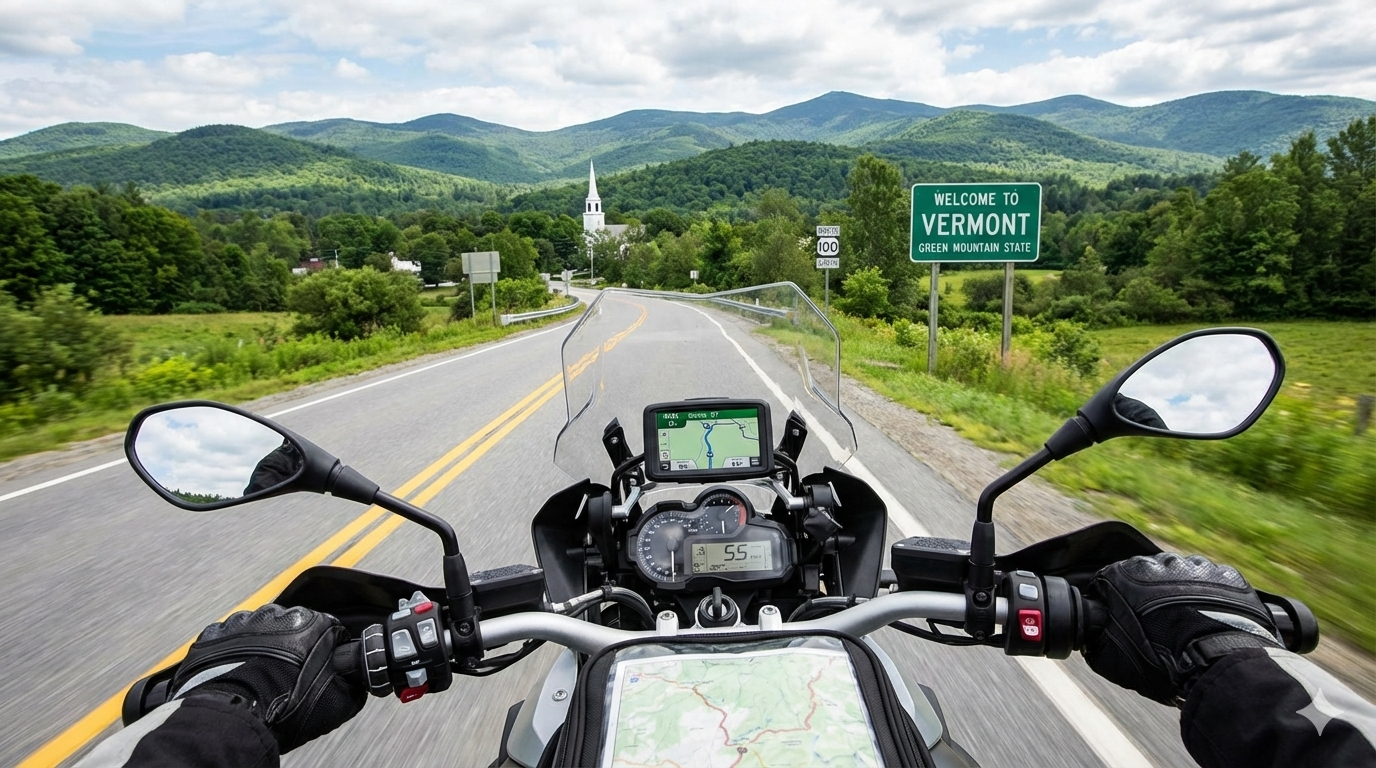
In Montréal, we are spoiled by the Laurentians and the Eastern Townships, but there is a specific, almost cinematic thrill that comes with crossing the border. It’s the moment the “Welcome to New York” or “Vermont: Green Mountain State” signs appear, and the pavement suddenly transforms from a lunar landscape into a smooth, sweeping ribbon of black satin.
Crossing the border isn’t just a change in geography; it’s a change in state of mind. Here is the manifesto for the Montréal rider ready to trade the 514 for the high peaks and green valleys of our southern neighbors.
The Portal: Surviving the Logistics
The border is a filter. For the rider, it requires a bit more “mental wrenching” than a trip to the grocery store. In 2026, the basics remain the same, but the mindset is key. You need your passport or your Nexus card, of course, but you also need your proof of insurance (the “Green Card” or equivalent).
The real challenge, however, is the Metric Flip. The second you cross into New York or Vermont, your brain has to recalibrate. 100 km/h becomes a distant memory; you are now living in a world of 55 and 65 mph. For those of us on electric bikes like the NIU or vintage mopeds, this is less of a speed issue and more of a “range math” issue. If you’re calculating your battery percentage or your fuel reserve, remember that a mile is 1.6 kilometers of hard-earned road.
The Adirondacks: The Vertical Frontier
If you head south through Lacolle and hit the I-87, you are entering the Adirondack Park — six million acres of rugged, vertical wilderness. This is the “big mountain” experience.
The crown jewel for any Montréal rider is Route 73, the climb from Keene into Lake Placid. It is a high-speed, sweeping ascent through a narrow valley of sheer rock faces and alpine lakes. You’ll feel the temperature drop as you climb towards the Olympic village, the air getting thinner and crisper.
But the “secret” of the Adirondacks for the twisty-obsessed is Tracy Road (County Road 6). Often called the “Dragon of the North,” this eleven-mile stretch between the I-87 and Moriah is a relentless series of over 50 turns. There are no driveways, no intersections, and almost no traffic. It is a technical masterclass in lean angles and throttle control. For a rider used to the grid-lock of Boulevard Saint-Laurent, Tracy Road feels like a different planet.
Vermont: The Pastoral Curve
If the Adirondacks are about raw, rugged power, Vermont is about the flow. Crossing at Highgate Springs puts you on the doorstep of Route 100, arguably the best motorcycle road in the Northeastern United States.
Route 100 is a 350-km spine that runs the entire length of the state. It takes you through the heart of the Green Mountains, past cider mills, craft breweries, and white-steeple villages that look like they were designed for a postcard. For the rider, it offers a “Goldilocks” rhythm—curves that aren’t so tight they’re exhausting, but winding enough to keep your tires warm.
If you want a challenge, you hunt the “Gaps.” These are the narrow mountain passes that cut across the Green Mountain spine. Appalachian Gap (Route 17) is the most famous, featuring a series of switchbacks near the summit that will test your low-speed balance and your confidence. At the top, there’s a pull-off where you can look back toward Lake Champlain and see the distant silhouette of the Adirondacks you just conquered.
The Weekend Rhythm: A Saturday-Sunday Loop
A classic “Montréal Escape” doesn’t need a week; it just needs forty-eight hours of clear weather.
- Saturday: Cross at Lacolle, take the 9N along the Adirondack Coast of Lake Champlain, then cut inland to Lake Placid. Spend the night in a motel or camp near the High Peaks.
- Sunday: Take the ferry from Essex, NY to Charlotte, VT (a literal floating break for your bike). Once in Vermont, hit Route 100 North through Stowe, grab a cider donut at the Cold Hollow Cider Mill, and meander through the islands of Lake Champlain on Route 2 as you head back toward the border.
By the time you hit the Jacques-Cartier Bridge on Sunday night, the orange cones of Montréal will still be there. The potholes will still be waiting. But you’ll be riding with the satisfaction of a thousand curves in your muscle memory, and the knowledge that the border is always there, waiting to be crossed.
Leave a Reply