
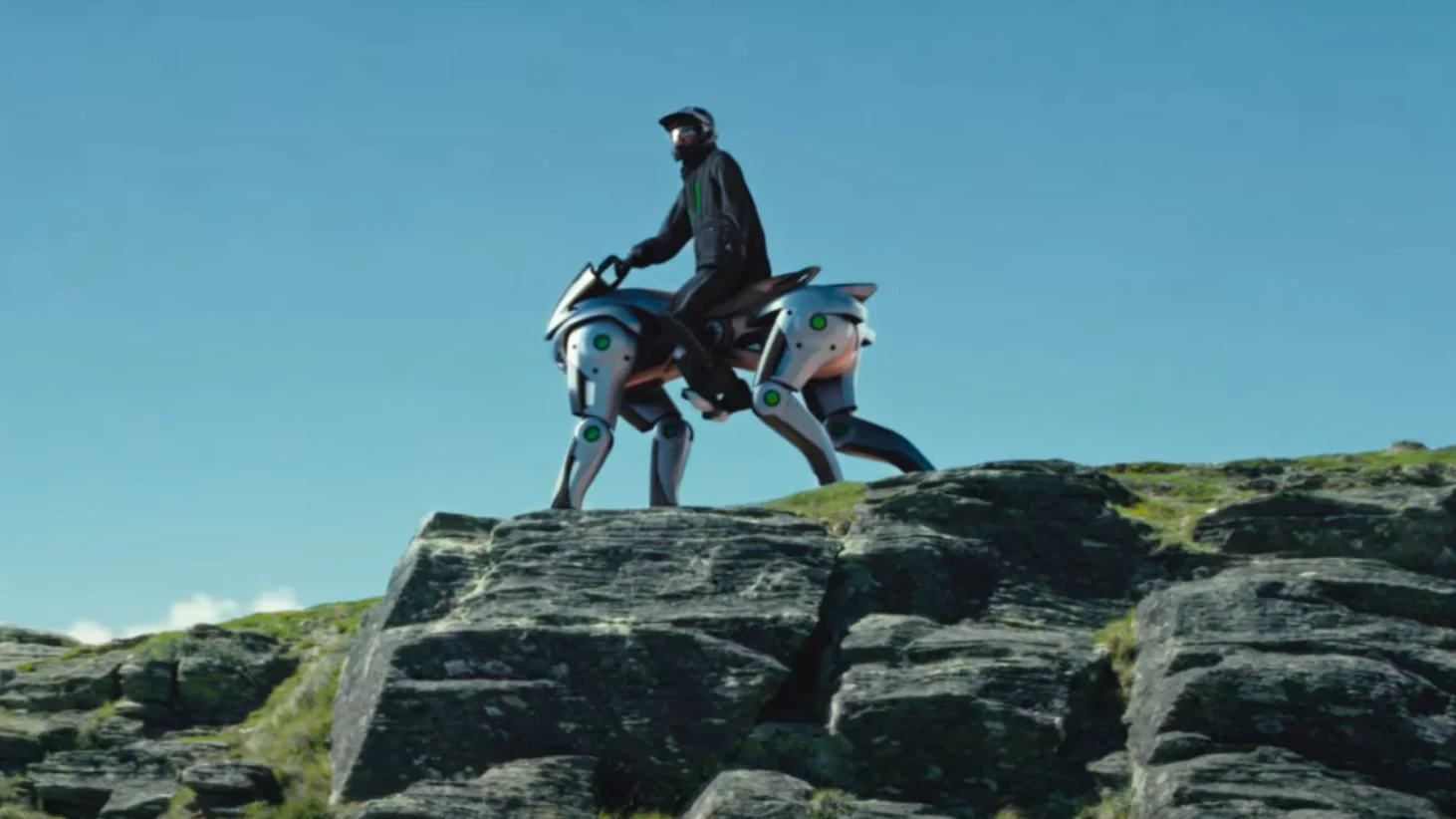
Assessing the Legality and the Landscapes for Kawasaki’s Robotic “Horse.”
The End of the Wheel?
The world of motorcycles has always been about the evolution of the wheel. We’ve spent a century trying to make the perfect circle — stickier rubber, lighter rims, more sophisticated suspension to keep those two contact points glued to the asphalt. But Kawasaki, a company that has famously built everything from bullet trains to the supercharged Ninja H2, recently decided that maybe the wheel was just a phase.
Enter the Kawasaki Corleo.
Unveiled as a glimpse into the future of “Safe Adventure,” the Corleo is a literal mechanical horse. It’s a quadruped robot designed to be ridden, blending the DNA of a motorcycle with the articulating legs of a mountain goat. As we sit here in January 2026, watching the Dakar riders battle the dunes on their high-tech rally bikes, the Corleo presents a radical alternative: What if, instead of rolling over the terrain, we simply stepped over it?
The Anatomy of a Metal Steed
To understand the Corleo, you have to look past the sci-fi aesthetics and into its mechanical soul. It isn’t powered by a massive battery pack like my NIU; instead, it uses a 150cc hydrogen-powered engine that acts as a generator. That electricity is sent to independent drive units in each of its four legs, which end not in tires, but in split, slip-resistant rubber “hooves.”
The control scheme is where things get truly “equestrian.” There are no traditional foot pegs or gear shifters. Instead, the rider stands or sits in adjustable stirrups, and the machine monitors weight shifts through the handlebars and the saddle. You lean forward to go, back to slow, and shift your weight to “direct” the machine’s gait. It’s a synthesis of human intent and robotic response that feels less like operating a vehicle and more like partnering with a biological entity.
The Canadian Legal Wall: Can it Hit the Pavement?
Now, let’s address the first big question: Could you ever ride a Corleo to get groceries in a Canadian city?
The short answer is a resounding “probably not.” Canada’s Motor Vehicle Safety Act (MVSA) is one of the most rigorous in the world, and it is built entirely on the assumption that vehicles have wheels. Currently, transport categories are rigid. To be a “Motorcycle,” you need two or three wheels. To be a “Low-Speed Vehicle,” you need four wheels and an electric powertrain. A quadruped robot with “hooves” doesn’t just fail to meet the criteria — it doesn’t even have a category to fail in.
Even if Kawasaki managed to fit it with the mandatory headlights, turn signals, and mirrors (which the Corleo concept does have), the stability and speed would be the dealbreakers. Legged mobility is inherently slower and more complex than rolling on a paved surface. On a smooth road, a wheel is the peak of efficiency; a leg is an over-engineered liability. Provincial Highway Traffic Acts across the country would likely classify this as an “Off-Road Vehicle” (ORV) at best, restricting it to trails and private land, much like a side-by-side or a dirt bike. You won’t be “galloping” down the 401 anytime soon.
The Canadian Wilderness: Where Legs Beat Wheels
But the Corleo wasn’t built for the 401. It was built for the places where a wheel—no matter how knobby the tire — simply gives up. And that is where Canada’s unique geography comes into play.
Think about the Canadian Shield. Millions of square kilometers of ancient, jagged rock, boggy muskeg, and fallen timber. In northern Ontario or the Laurentians, a traditional ATV or dirt bike eventually hits a “wall” — a rock face too steep or a log jam too dense. The Corleo, however, is designed to kneel, step, and climb. Its articulating rear swingarm allows it to keep the rider level while the hooves find purchase on uneven ledges that would bottom out any traditional suspension.
Imagine exploring the Rocky Mountains of British Columbia. Traditional trails are often limited by the “switchback” logic of wheeled vehicles. A quadruped could, in theory, navigate technical “goat paths” or climb through loose scree fields where a tire would just spin and bury itself. The Corleo’s AI-assisted balance system means it can navigate a 30-degree incline while the rider simply focuses on the horizon.
In the Boreal Forest of the Yukon or the Northwest Territories, where the ground is a constant battle between permafrost and mud, the “hoof” design offers a different kind of traction. By distributing weight across four points that can move independently, the Corleo can avoid the “trenching” effect that ruins trails and gets wheeled bikes stuck in the muck.
A New Breed of Exploration
The Kawasaki Corleo represents a fundamental shift in how we think about “horsepower.” It’s an acknowledgment that while wheels conquered the 20th century, they might not be the final answer for the 21st century’s “last mile” of exploration.
For the Canadian rider, the Corleo isn’t a replacement for the motorcycle; it’s a companion for the wilderness. It’s a machine for the hunter, the search-and-rescue team, or the hardcore explorer who wants to see what’s on the other side of the ridge where the trail ends.
As we look toward the production models slated for the next decade, we aren’t just looking at a new bike. We’re looking at the return of the horse — this time, it just happens to run on hydrogen and code.
Leave a Reply